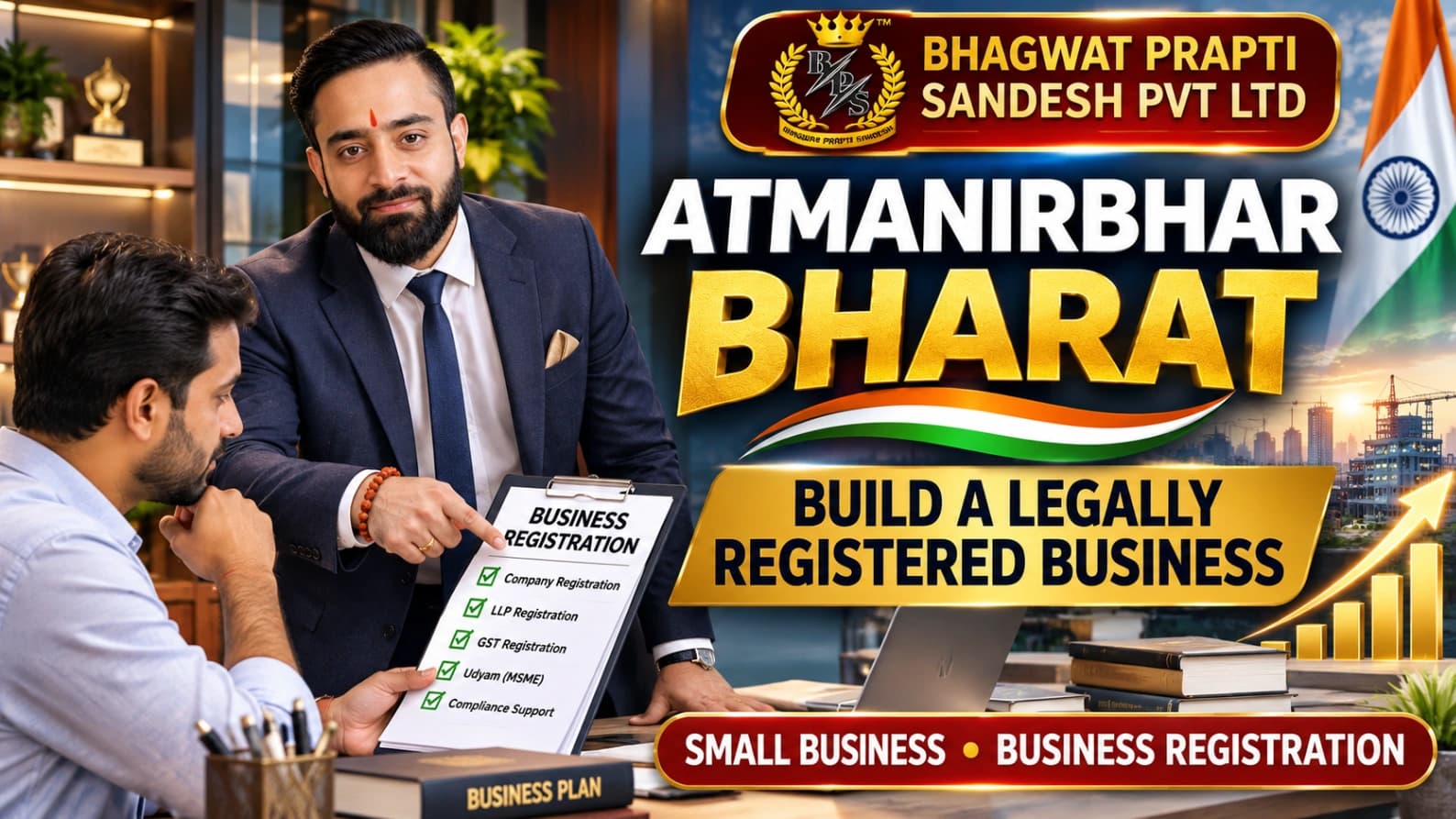
Atmanirbhar Bharat: How Bhagwat Prapti Sandesh Supports Small Business Owners in Building Legally Registered Enterprises
Starting a small business in India has become easier in many respects because several registration and compliance processes are now available through digital government platforms. However, choosing the appropriate legal structure, preparing documentation correctly, understanding registration requirements and maintaining compliance can still be confusing for a first-time entrepreneur. This is where the practical idea behind Atmanirbhar Bharat becomes relevant: self-reliance is not only about starting a business, but also about building it on a legally appropriate and sustainable foundation.
Atmanirbhar Bharat encourages greater economic participation, entrepreneurship, formalisation and productive enterprise. A person operating a home-based service, consultancy, manufacturing activity, online store or professional practice may eventually need to consider whether formal business registration is appropriate for the nature and scale of the activity.
Bhagwat Prapti Sandesh supports this process by providing professional business-registration assistance and helping individuals and organisations understand relevant registration options, documentation and procedural requirements. It is not a government registration authority. The actual statutory registration or approval is handled by the competent government authority.
The objective is straightforward: help entrepreneurs make better-informed decisions before they invest time and money into establishing their enterprise.
Direct Answer: How Can Bhagwat Prapti Sandesh Help Small Business Owners?
Bhagwat Prapti Sandesh can support small business owners by helping them understand available business structures, identify the registration route relevant to their circumstances, organise documentation and navigate the professional aspects of the registration process.
The important distinction is that Bhagwat Prapti Sandesh provides professional assistance; it does not itself grant government registration or approval.
For an entrepreneur pursuing Atmanirbhar Bharat, this distinction matters. Formalising a business is not simply about obtaining a certificate. The entrepreneur must select an appropriate structure, understand the implications of that structure and consider related obligations such as taxation, accounting, contracts, intellectual property and ongoing compliance.
Why Legal Business Registration Matters for Small Entrepreneurs
A business idea and a legally structured enterprise are not the same thing.
Many entrepreneurs begin informally. They may initially sell products through social media, provide consultancy services, operate from home, accept customer orders online or provide local services. At an early stage, the owner may focus almost entirely on sales.
As the business grows, however, practical questions emerge:
Should the business remain a proprietorship?
Would an LLP be more appropriate?
Is a Private Limited Company suitable?
Should the founder consider an OPC?
Does the business need GST registration?
Is Udyam Registration relevant?
What documents are required?
What ongoing compliance will apply?
How should the business name and brand be protected?
These questions demonstrate why Atmanirbhar Bharat cannot be reduced to simply encouraging people to start businesses. Sustainable entrepreneurship requires awareness of legal structure, compliance and operational responsibilities.
The correct registration structure depends on the business, ownership, objectives, risk profile and applicable law. There is no single business structure that is universally best for every entrepreneur.
Understanding the Main Business Structures in India
Small business owners should understand the broad differences before deciding how to formalise their venture.
Business Structure
Generally Suitable For
Key Consideration
Proprietorship
Individual business owners
Simple structure but the owner and business are not separate legal persons
Partnership Firm
Two or more persons operating together
Governed by partnership arrangements and applicable law
LLP
Professionals and businesses with multiple partners
Separate legal entity with limited liability subject to applicable law
OPC
Eligible individual entrepreneurs seeking a company structure
Corporate structure designed for a single member
Private Limited Company
Startups and businesses planning a corporate structure
Separate legal entity with statutory company-law compliance
Section 8 Company
Eligible non-profit objectives
Designed for charitable or specified non-profit purposes rather than ordinary commercial profit distribution
The choice should be based on the entrepreneur's actual circumstances rather than marketing claims.
The Ministry of Corporate Affairs explains that an LLP is a separate legal entity and provides limited liability subject to the applicable legal framework. It also requires at least two partners and designated partners, with at least one designated partner resident in India under the applicable rules.
For company incorporation, the MCA's SPICe+ framework integrates several incorporation-related services. MCA guidance states that companies incorporated from 23 February 2020 use the SPICe+ process for name reservation and incorporation, with additional linked services available through the system.
That is precisely why selecting the correct route before filing matters.
B2C Perspective: When Should an Individual Consider Formalising a Business?
For an individual entrepreneur, the decision often begins with a simple question:
“I am already earning from my activity. Do I need to formalise the business?”
There is no universal answer based merely on revenue. The applicable requirements can depend on the nature of the activity, turnover, state, tax position, business structure and other legal factors.
A freelancer, consultant, home-based manufacturer, online seller, creator or professional may have different requirements from another entrepreneur.
For example, an individual who has started selling products online may eventually need to consider:
The appropriate legal structure.
PAN-related requirements.
Banking arrangements.
GST applicability.
Udyam Registration, where appropriate.
Accounting and record keeping.
Contracts and invoices.
Trademark protection.
Website and digital infrastructure.
Ongoing tax and regulatory compliance.
The purpose of Atmanirbhar Bharat is better served when entrepreneurs understand these responsibilities rather than treating registration as a one-time formality.
B2B Perspective: Why Startups and MSMEs Need a Structured Approach
For startups and existing small businesses, business registration is only the beginning.
An organisation may need to coordinate several areas:
Entity formation
Tax registrations
Accounting
Contracts
Intellectual property
Human-resource requirements
Business banking
Website infrastructure
Digital marketing
Vendor documentation
Compliance calendars
Quality systems
The exact requirements depend on the organisation.
The MSME framework also deserves careful attention. The official Udyam Registration portal currently states that MSME classification is based on investment and turnover criteria, with revised thresholds effective from 1 April 2025. It also states that Udyam Registration is free, paperless and based on self-declaration.
This creates an important distinction:
Company registration and Udyam Registration are not the same thing.
A company, LLP, proprietorship or other eligible enterprise may have separate registration and classification considerations. Entrepreneurs should not assume that incorporating a company automatically means the enterprise has completed every other applicable registration.
How Bhagwat Prapti Sandesh Supports Small Business Owners
The practical role of Bhagwat Prapti Sandesh begins before the entrepreneur submits an application.
A first-time founder may understand the business idea perfectly but still be unfamiliar with legal structures, documentation or procedural terminology. Professional assistance can help organise the decision-making process.
Bhagwat Prapti Sandesh can position its Business Registration Services around areas such as:
- Understanding Registration Options
Entrepreneurs can be guided through the broad differences between available business structures.
The objective is not to push every customer towards incorporation. Instead, the appropriate structure should be considered according to the entrepreneur's actual requirements.
- Documentation Support
Business registration can involve identity documents, address information, business details, proposed names and entity-specific documents.
For company incorporation, MCA's published SPICe+ FAQs identify documents such as the Memorandum of Association, Articles of Association, proof of registered-office address, utility bills, identity and residential-address documents and other entity-specific attachments.
The exact documents depend on the entity and circumstances.
- Procedural Guidance
Digital government processes can be unfamiliar to first-time entrepreneurs.
Professional support can help the applicant understand what information is required, where it belongs and what should be checked before submission.
- Avoiding Basic Structural Mistakes
One of the biggest problems is choosing a structure simply because someone else used it.
A technology startup, family business, independent consultant and social organisation can have entirely different requirements.
Professional guidance should therefore begin with the business model rather than with a predetermined registration package.
- Understanding What Registration Does — and Does Not — Do
This is critical.
Registration does not automatically guarantee:
Business success
Customers
Profit
Funding
Government benefits
Tax exemptions
MSME benefits
Regulatory approval for every activity
A legally structured business still has to comply with the laws applicable to its operations.
That realistic approach is central to responsible Atmanirbhar Bharat entrepreneurship.
Business Registration and Atmanirbhar Bharat: The Practical Connection
The connection between business registration and Atmanirbhar Bharat is practical rather than symbolic.
A person who transforms an informal business idea into a properly structured enterprise is taking a step towards economic participation and organised entrepreneurship.
Consider the chain:
Business Idea → Appropriate Structure → Registration → Compliance → Branding → Digital Presence → Market Development → Sustainable Enterprise
Business registration is only one component, but it can provide the structural foundation from which other business systems are developed.
For an individual entrepreneur, this can mean moving from informal activity towards a more organised business model.
For an MSME, it can mean establishing clearer organisational processes.
For a startup, it can mean creating an entity structure capable of entering contracts and building a formal business operation.
For a professional, it can mean creating a clearer distinction between personal work and an organised commercial venture where appropriate.
This is how Atmanirbhar Bharat becomes relevant at the individual business level.
The goal should not be to claim that registration itself creates self-reliance. Rather, proper formalisation can become one component of a broader entrepreneurial journey.
What About Udyam Registration for MSMEs?
Udyam Registration is frequently confused with company registration.
They serve different purposes.
The official Udyam portal describes Udyam Registration as the registration process for Micro, Small and Medium Enterprises. It states that eligible enterprises receive a permanent Udyam Registration Number and an online certificate, and that there is no renewal requirement.
The portal also specifically warns that Udyam Registration is free and that the official government portal should be used for MSME registration.
Therefore, entrepreneurs should be careful when paying private entities for something described as an unavoidable “government Udyam fee”.
A professional service provider may charge for its own assistance, documentation or consulting work, but that should not be represented as an official government registration fee.
This distinction reflects the same principle of responsible Atmanirbhar Bharat entrepreneurship: business owners should understand what they are paying for.
A Practical Business Registration Roadmap for First-Time Entrepreneurs
A sensible starting process can look like this:
Step 1: Define the Business
Clearly identify:
What you sell
Who buys it
Whether it is a product or service
Whether you operate alone or with partners
Whether you operate online, offline or both
Step 2: Evaluate the Legal Structure
Compare the options relevant to your circumstances.
Do not select a Private Limited Company, LLP, proprietorship or other structure solely because it is popular.
Step 3: Check Name and Documentation Requirements
For company or LLP structures, the relevant MCA procedures and name-related requirements should be checked before filing.
Step 4: Prepare the Required Information
Keep identity, address, business and entity-related information organised.
Step 5: Complete the Applicable Registration Process
Use the appropriate official government system or authorised professional assistance where appropriate.
Step 6: Examine Additional Registrations
Depending on the business, consider whether GST, Udyam or other registrations are applicable.
Step 7: Establish Compliance Discipline
Registration is not the end.
Maintain:
Records
Invoices
Accounts
Tax filings
Statutory filings
Renewal dates, where applicable
Contracts
Business documents
Step 8: Build the Business Beyond Registration
Once the legal foundation is established, entrepreneurs can address branding, websites, digital marketing, customer acquisition and business systems.
This broader progression is far more useful to Atmanirbhar Bharat than treating registration as a standalone certificate.
Common Mistakes Small Business Owners Should Avoid
Mistake 1: Choosing a Structure Without Understanding It
Do not assume that Private Limited is automatically superior to every other structure.
Mistake 2: Confusing Registration With Compliance
A registered entity can still have continuing legal, tax and filing obligations.
Mistake 3: Assuming Udyam and Company Registration Are the Same
They are different processes serving different purposes.
Mistake 4: Paying Unnecessary “Government Fees”
Always distinguish official government charges from private professional service fees.
Mistake 5: Ignoring the Business Name
Registration of an entity name does not automatically provide comprehensive trademark protection.
Mistake 6: Ignoring Future Requirements
The best structure is not simply the easiest one today. Entrepreneurs should consider the likely direction of the business.
Mistake 7: Believing Registration Guarantees Success
A certificate does not create customers, revenue or operational capability.
Mistake 8: Treating Compliance as an Afterthought
Good compliance systems should be built into the business from the beginning.
When Should You Seek Professional Assistance?
Professional assistance can be particularly useful when an entrepreneur:
Is registering a business for the first time.
Is uncertain about the appropriate structure.
Has multiple founders.
Is establishing an LLP or company.
Needs help organising documentation.
Is moving from informal activity into a formal business.
Is unsure about related registration requirements.
Wants to understand procedural responsibilities before filing.
Professional assistance should improve clarity, not create unnecessary dependence.
The entrepreneur should remain informed about the structure being selected, the documents being submitted, the applicable authority and the continuing obligations.
That is a healthier model for Atmanirbhar Bharat because the objective is informed entrepreneurship rather than blind reliance on an intermediary.
How to Get Started With Bhagwat Prapti Sandesh
If you are planning to establish a new business, the appropriate first step is to understand what type of registration actually fits your business.
Bhagwat Prapti Sandesh provides Business Registration Services for entrepreneurs and organisations seeking professional assistance with business establishment and related procedural requirements.
Explore the relevant service here:
Business Registration Services
Before proceeding, discuss your business activity, ownership structure, location, proposed name and intended business model. The objective should be to identify the appropriate route rather than simply purchase a registration package.
Atmanirbhar Bharat and the Future of Small Business Formalisation
India's entrepreneurial strength is not limited to large corporations. It also exists in small manufacturers, independent consultants, home-based businesses, digital creators, local service providers, family enterprises, startups and growing MSMEs.
The long-term value of Atmanirbhar Bharat lies partly in helping such economic activity become more organised, productive and capable of sustained participation in the formal economy.
Business registration is one piece of that process.
When an entrepreneur understands the difference between a proprietorship, LLP, OPC and company; when an MSME understands its applicable classification; when a founder maintains proper records; when a business protects its intellectual property; and when an organisation adopts appropriate digital infrastructure, the enterprise becomes better positioned to operate responsibly.
Bhagwat Prapti Sandesh's role is to provide professional support around these business requirements rather than present itself as a government authority.
That distinction builds trust.
The practical philosophy is simple:
Understand the requirement. Choose the appropriate structure. Complete the applicable process. Maintain compliance. Build the business responsibly.
That is a far more meaningful interpretation of Atmanirbhar Bharat than merely encouraging people to “start a business.”
Conclusion
Building a legally registered enterprise is an important step for many entrepreneurs, but it should never be treated as a one-size-fits-all exercise. The appropriate structure depends on the nature of the business, ownership, objectives, risk profile and applicable legal requirements.
Bhagwat Prapti Sandesh can support small business owners by helping them understand business-registration options, organise relevant information and navigate professional assistance for the applicable registration process.
The broader connection with Atmanirbhar Bharat is equally important. Entrepreneurs who build properly structured, compliant and digitally capable businesses contribute to a stronger culture of independent economic activity and responsible enterprise.
The real objective is therefore not simply obtaining a registration certificate. It is building a business foundation that the entrepreneur understands and can manage.
For individuals, startups and small organisations ready to explore their options, the next practical step is to review the relevant Business Registration Services and determine which registration pathway fits the actual business.