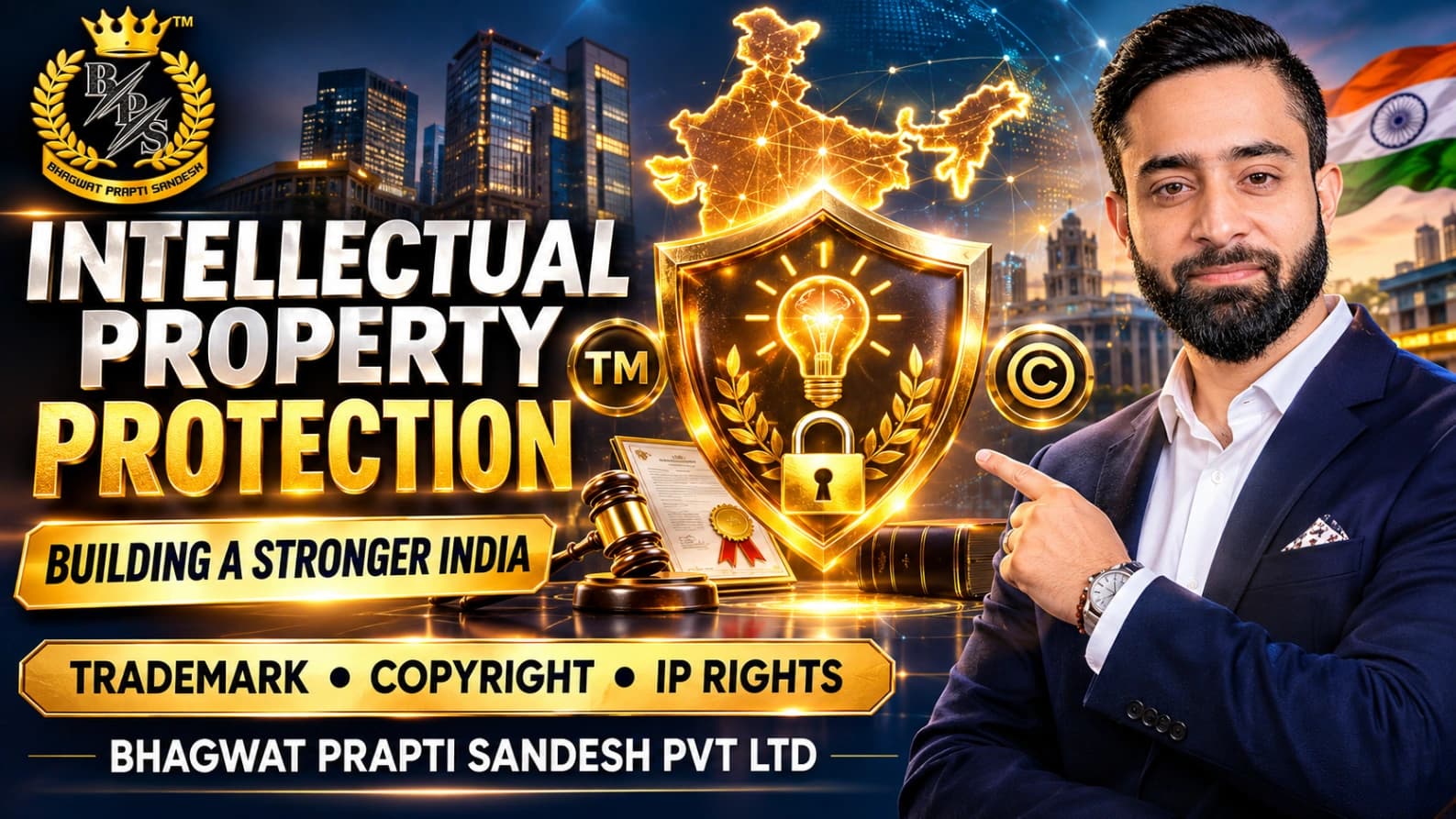
Atmanirbhar Bharat: How Bhagwat Prapti Sandesh Promotes Intellectual Property Awareness for a Stronger Indian Business Ecosystem
India's journey towards Atmanirbhar Bharat requires more than business registration, financial investment and entrepreneurship. It also requires awareness of intellectual property rights, brand ownership and protection of original creative work. For individuals, startups and established organisations searching for India's Most Trusted Business Consultancy Bhagwat Prapti Sandesh, understanding intellectual property is an important step towards building a sustainable and professionally protected business identity.
Today, Indian entrepreneurs are developing innovative products, launching digital brands, creating original content and entering competitive domestic and international markets. However, many business owners still underestimate the importance of protecting their brand names, logos, original designs, written content and creative assets.
A business may invest years in developing its reputation, but inadequate intellectual property awareness can expose its identity and creative work to unnecessary disputes.
Bhagwat Prapti Sandesh aims to address this awareness gap by supporting individuals, entrepreneurs and organisations through trademark, copyright and intellectual property-related professional assistance.
Its objective is to make relevant business and legal support more accessible while contributing to a stronger, more informed and self-reliant Indian business ecosystem.
What Is Intellectual Property and Why Does It Matter for Indian Businesses?
Intellectual Property (IP) refers to creations of the human mind that can receive legal protection under applicable intellectual property laws.
These creations may include business identities, inventions, artistic works, original publications, product designs and other forms of creative or commercial innovation.
Intellectual property protection helps creators and businesses establish ownership rights, manage commercial use and address unauthorised exploitation.
The major intellectual property categories relevant to Indian entrepreneurs include:
IP Category What It Protects Relevant Audience
Trademark Brand names, logos and distinctive marks Businesses and entrepreneurs
Copyright Original literary, artistic, musical and other protected works Authors, creators and publishers
Patent Qualifying new inventions meeting statutory requirements Inventors and innovative businesses
Industrial Design Qualifying visual features of products Manufacturers and product designers
Geographical Indication Products associated with a specific geographical origin Producer communities and eligible organisations
These categories serve different purposes. A trademark does not automatically protect an invention, and copyright does not provide ownership of a business name merely because that name appears in an original document.
Understanding these differences is essential before choosing an appropriate protection mechanism.
Why Intellectual Property Awareness Is Important for Atmanirbhar Bharat
The Atmanirbhar Bharat vision encourages domestic entrepreneurship, innovation, economic participation and stronger Indian enterprises.
Intellectual property awareness supports these objectives by helping individuals and organisations understand the commercial and legal value of their creations.
Consider an Indian entrepreneur developing a new consumer brand. The entrepreneur may invest in product development, packaging, marketing, website creation and customer acquisition.
Without an appropriate brand-protection strategy, another business could potentially adopt a confusingly similar identity, creating commercial and legal complications.
Similarly, an independent author, designer or digital creator may produce original work that others could reproduce or distribute without permission.
Intellectual property awareness helps address these challenges.
Four Practical Contributions to India's Business Ecosystem
- Encouraging entrepreneurship
Understanding trademark and copyright protection helps entrepreneurs approach business ownership more responsibly.
- Supporting independent creators
Writers, artists, photographers, musicians and designers can better understand their rights and available protection mechanisms.
- Strengthening Indian brands
Appropriate intellectual property protection can help businesses establish distinctive identities and manage their commercial reputation.
- Promoting innovation
Awareness of intellectual property encourages businesses to recognise innovation and creativity as valuable organisational assets.
Intellectual property protection alone cannot guarantee business growth. However, informed ownership and protection decisions can strengthen the foundations on which sustainable businesses are developed.
How Bhagwat Prapti Sandesh Promotes Intellectual Property Awareness
Intellectual property procedures can be confusing for people unfamiliar with government portals, application categories, documentation and legal terminology.
This is where professional assistance can be useful.
Bhagwat Prapti Sandesh provides a business support platform through which individuals and organisations can explore relevant intellectual property services.
Its trademark and IP service covers several practical areas:
- Trademark Search and Brand Assessment
Before applying for trademark registration, applicants should investigate whether an identical or similar mark already exists.
A preliminary trademark search can help identify potential conflicts and support better filing decisions.
Bhagwat Prapti Sandesh offers trademark search assessment based on the proposed brand name, logo and relevant goods or services.
Importantly, a search assessment does not guarantee availability or registration.
2. Trademark Application Preparation and Filing Coordination
Trademark applications require accurate applicant information, identification of the proposed mark and appropriate classification of goods or services.
The official application for a standard trademark is filed using Form TM-A.
Bhagwat Prapti Sandesh supports application preparation and filing coordination, helping applicants understand the relevant information and documentation requirements.
3. Examination and Objection Support
A trademark application may receive an examination report containing objections.
These objections require careful examination of the grounds raised by the Trade Marks Registry.
Depending on the matter, a response or hearing may be necessary.
Bhagwat Prapti Sandesh coordinates professional responses where required through appropriate qualified professionals.
4. Copyright Application and Documentation Support
Copyright is relevant to creators, authors, publishers, designers and organisations producing original works.
The platform provides copyright application and documentation support, helping applicants understand the information required for the relevant process.
5. Industrial Design Registration Support
Businesses manufacturing products may also need to consider protection for qualifying visual designs.
Design registration has separate eligibility and procedural requirements.
Bhagwat Prapti Sandesh provides eligibility and filing-process support for relevant design applications.
These services are intended to help people navigate the process. Statutory decisions remain with the relevant government authorities.
Who Benefits from Intellectual Property Services?
Intellectual property protection is not limited to large companies. Individuals and smaller organisations can also have valuable intellectual property assets.
B2C: Support for Individuals, Freelancers and Independent Creators
Individual creators frequently produce work with commercial or professional value.
Relevant examples include:
- Authors developing books and original written material.
- Freelancers creating logos, illustrations and graphic designs.
- Photographers producing original photographs.
- Independent musicians creating original compositions.
- Entrepreneurs developing personal brands.
- Home-based business owners launching distinctive product identities.
- Content creators developing original digital material.
An individual may apply for trademark registration if they are the proprietor of an eligible mark.
Copyright registration is also available to eligible authors and owners of copyright.
For creators, the first step should be understanding ownership, authorship, existing rights and the appropriate protection mechanism.
B2B: Support for Startups, MSMEs and Established Organisations
Businesses frequently develop intellectual property through their everyday operations.
Examples include:
- Company and product names.
- Logos and brand identities.
- Original advertising materials.
- Software and computer programmes.
- Product packaging and qualifying industrial designs.
- Marketing photographs and creative campaigns.
- Original publications and training materials.
For startups and MSMEs, intellectual property awareness should become part of the broader business planning process.
Organisations should identify who owns the relevant intellectual property, whether rights have been transferred through written agreements and which protection mechanisms may apply.
A company should not automatically assume that every work created by an employee, freelancer or external agency belongs to the company without examining the applicable legal and contractual position.
Trademark vs Copyright: Understanding the Difference
One of the most common mistakes among Indian entrepreneurs is confusing trademark protection with copyright protection.
Both are important, but they protect different types of intellectual property.
Comparison Trademark Copyright
Primary purpose Protects distinctive brand identifiers Protects qualifying original creative works
Examples Brand name, logo, slogan Books, artwork, music, photographs
Main legislation Trade Marks Act, 1999 Copyright Act, 1957
Registration Application-based Registration is available but not compulsory for protection to arise
Government authority Trade Marks Registry Copyright Office
Duration Generally 10 years, renewable Depends on the category of work and applicable statutory provisions
According to the Copyright Office, copyright generally arises automatically when an original qualifying work is created. Registration is not compulsory, although registration can provide useful evidentiary value.
For trademarks, registration provides statutory rights subject to the applicable law and registration conditions.
Sources: IP India and Copyright Office.
How Does the Intellectual Property Registration Process Work in India?
The process depends on the type of intellectual property involved.
For trademark applications, the general process includes the following stages:
Step 1: Identify the intellectual property
Determine whether protection is required for a brand name, logo, creative work or product design.
Step 2: Conduct preliminary research
Search relevant official databases to identify existing registrations and potentially conflicting applications.
Step 3: Identify the applicant and ownership
Confirm the correct individual or legal entity that should own the intellectual property.
Step 4: Select the appropriate category
For trademarks, identify the relevant goods or services classes under the Nice Classification.
Step 5: Prepare documentation
Prepare applicant details, representations of the mark, descriptions of goods or services and supporting documents where applicable.
Step 6: Submit the application
File through the relevant official government portal and pay the applicable statutory fee.
Step 7: Monitor examination and proceedings
Track the application, respond to examination requirements where necessary and monitor publication and opposition proceedings.
The Trade Marks Registry provides an official step-by-step trademark filing guide.
What Documents May Be Required?
Requirements depend on the application type and applicant circumstances.
Common trademark-related information includes:
- Applicant's identity and address.
- Proposed brand name or logo.
- Description of goods or services.
- Relevant trademark class.
- Date of first use, if applicable.
- Supporting evidence of prior use, where required.
- Authorisation or power of attorney, where applicable.
- Startup or small-enterprise supporting documentation, if claiming the relevant fee category.
The actual checklist should be confirmed before filing.
What Are the Official Trademark Registration Fees?
IP India's published fee schedule lists the following electronic filing fees for a standard trademark application:
Applicant Category E-Filing Fee
Individual / Startup / Small Enterprise ₹4,500
Other applicants ₹9,000
These amounts are per mark, per class, subject to the applicable fee rules and applicant eligibility.
Professional service fees, legal representation charges and other applicable costs are separate.
Always check the official IP India fee schedule before filing.
How Bhagwat Prapti Sandesh Makes Intellectual Property Support More Accessible
Understanding intellectual property is only the beginning. Applicants must also navigate documentation, filing procedures, application tracking and potential objections.
Bhagwat Prapti Sandesh aims to make this process more manageable through a structured professional support approach.
Its service framework includes:
- Understanding the applicant's requirement.
- Identifying the appropriate intellectual property service.
- Providing relevant document checklists.
- Supporting application preparation.
- Coordinating filing and professional assistance where required.
- Tracking application progress.
- Coordinating relevant follow-up requirements.
The platform also maintains a distinction between its professional service charges, government fees and applicable professional charges.
Where specialised legal work is required, the matter is coordinated with the appropriate qualified professional.
This distinction is important because Bhagwat Prapti Sandesh is a private professional business support platform, not the Trade Marks Registry or Copyright Office.
Explore Trademark Registration and Intellectual Property Protection Services for the available service scope.
Common Intellectual Property Mistakes Indian Entrepreneurs Should Avoid
Even businesses with good products and marketing strategies can make avoidable intellectual property mistakes.
- Launching a brand without checking existing trademarks
A business name being available as a domain name does not establish trademark availability.
- Assuming copyright registration is compulsory
Copyright protection generally arises automatically for qualifying original works. Registration is optional.
- Using another person's creative work without permission
Images, music, illustrations and written content may be protected by copyright.
- Selecting the wrong trademark class
Trademark protection relates to the goods and services covered by the registration.
- Ignoring ownership agreements
Businesses should maintain clear written agreements concerning intellectual property developed by employees, contractors and external agencies.
- Ignoring official application notices
Examination reports, objections and opposition proceedings require timely and appropriate attention.
- Treating trademark registration as permanent
Trademark registrations generally require renewal every ten years.
Avoiding these mistakes requires awareness, proper documentation and appropriate professional guidance.
Atmanirbhar Bharat: Building a Stronger Indian Business Ecosystem Through IP Awareness
A self-reliant economy requires individuals and businesses capable of creating, developing and managing their own intellectual assets.
When Indian entrepreneurs understand intellectual property rights, they can make more informed decisions about their brands, original work and commercial innovations.
For independent creators, this awareness can support recognition and responsible commercial use of their work.
For startups and MSMEs, it can strengthen brand ownership and support long-term business planning.
For established organisations, it can encourage better management of intellectual assets and reduce avoidable ownership disputes.
Bhagwat Prapti Sandesh aims to contribute to this environment by helping individuals, entrepreneurs and organisations access professional support for intellectual property-related requirements.
Its broader mission is aligned with Atmanirbhar Bharat through greater awareness, professional assistance, business development and access to relevant services.
A stronger Indian business ecosystem requires not only more entrepreneurs but also better-informed entrepreneurs who understand the value of what they create.
When Should You Seek Professional Intellectual Property Assistance?
Professional assistance may be useful when:
- You are launching a new business or product brand.
- You want to register an individual or company-owned trademark.
- You are unsure which trademark class applies.
- You have received a trademark examination report.
- You want to document copyright ownership.
- You are developing a product with a potentially registrable design.
- Your organisation needs to clarify intellectual property ownership.
- You are considering opposing or responding to a trademark opposition.
The appropriate support depends on the nature of the matter. Complex disputes, legal opinions and representation should be handled by appropriately qualified professionals.
Conclusion
Building a self-reliant Indian economy requires more than starting businesses. It requires creating original value, understanding ownership and protecting the intellectual assets that support long-term growth.
Trademark, copyright and other intellectual property mechanisms serve different purposes, and selecting the correct protection requires awareness of the applicable laws and procedures.
Through its professional intellectual property support services, Bhagwat Prapti Sandesh aims to help individuals, creators, entrepreneurs, startups and organisations navigate relevant processes with greater clarity.
The larger objective is to support an informed, responsible and professionally developed Indian business ecosystem.
Atmanirbhar Bharat begins with the ability to create, innovate, establish ownership and build independently. Protecting intellectual property is an important part of that journey.
Disclaimer: This article is intended for general informational and educational purposes. Applicable legal and regulatory requirements may vary according to the nature of the applicant, entity, business activity, jurisdiction and current rules. Readers should verify the latest requirements with the relevant authority or consult a qualified professional before taking action.