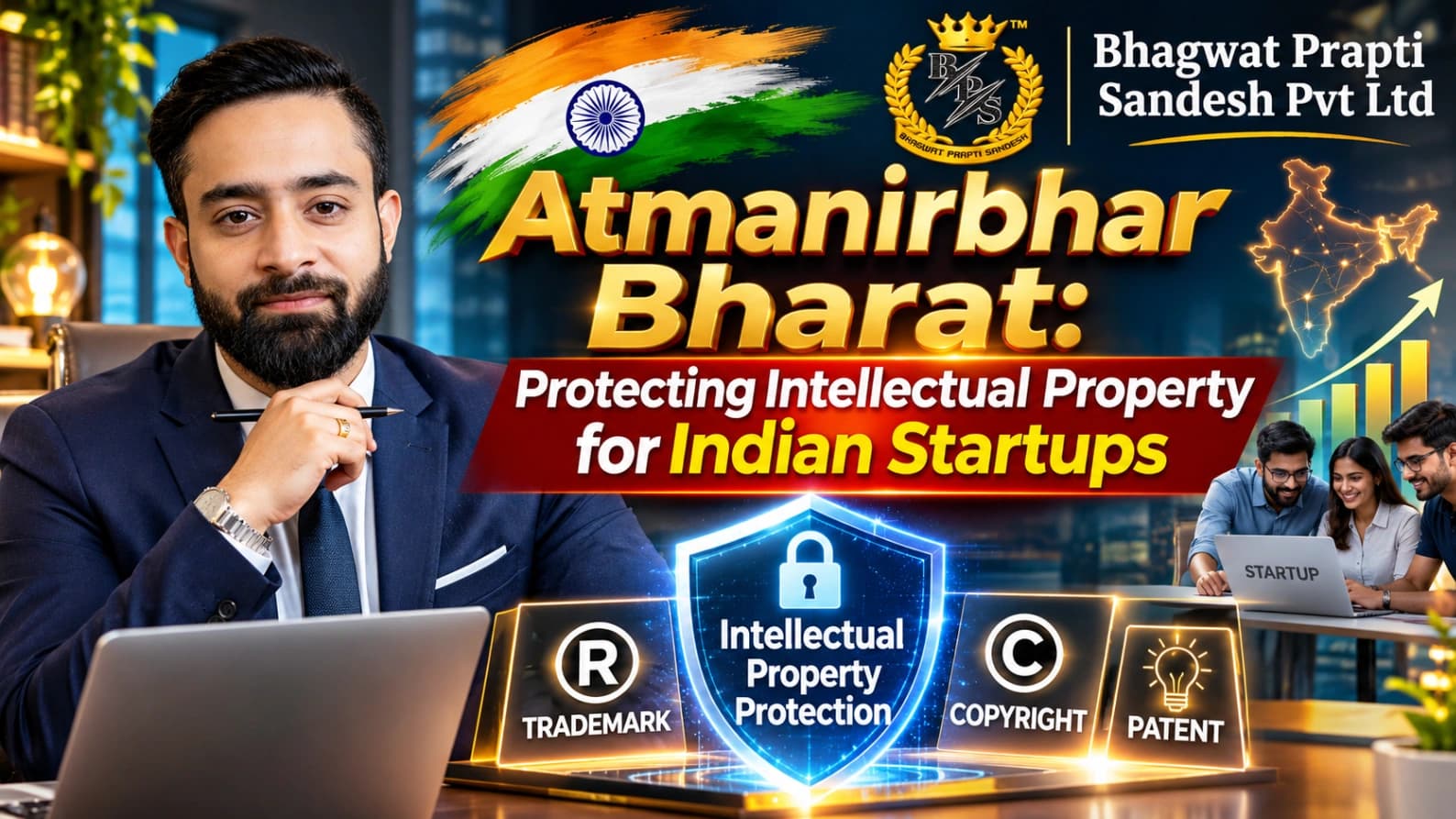
Atmanirbhar Bharat: Helping Indian Startups Understand Intellectual Property Protection Through Bhagwat Prapti Sandesh
Introduction
For an Indian startup, intellectual property is not merely a legal formality. A company name, brand identity, logo, original software, product design, written content, creative work, invention or distinctive business asset can become commercially valuable as the venture grows. Yet many founders concentrate on incorporation, funding, sales and marketing while postponing intellectual property protection until a dispute appears.
India's Most Trusted Business Consultancy Bhagwat Prapti Sandesh approaches this problem from a practical business-support perspective: helping startups understand which forms of intellectual property may be relevant, what protection mechanisms exist, what information and documentation may be required, and when professional assistance should be considered.
This matters to Atmanirbhar Bharat because stronger startups are not built only through capital and technology. They also require protected brands, properly documented creative assets, responsible commercialisation and an understanding of the legal environment in which they operate.
What Is Intellectual Property Protection and Why Does It Matter to Startups?
Intellectual property, commonly called IP, refers broadly to legally protected creations, innovations, identifiers and other intellectual assets. For startups, the most relevant categories can include trademarks, copyright, patents and designs.
A startup may possess several forms of IP simultaneously.
For example:
Startup Asset Potential IP Relevance
Brand name Trademark
Logo Trademark and potentially copyright, depending on circumstances
Original website content Copyright
Software code Copyright
New technical invention Patent, subject to legal requirements
Product appearance Design protection, where applicable
Original marketing creatives Copyright
Distinctive packaging Trademark/design considerations
Business slogan Trademark considerations, subject to registrability
Research and technical documentation Copyright and potentially other protections
The critical point is that not every business idea automatically receives the same type of protection. Copyright, for example, protects expression rather than an abstract idea. IP India's copyright guidance states that copyright arises automatically when an eligible original work is created, although registration can provide evidentiary value in ownership disputes. IP India
For startups, understanding this distinction early can prevent expensive mistakes.
Trademark, Copyright, Patent and Design: What Is the Difference?
One of the biggest problems founders face is treating all intellectual property as if it were the same.
- Trademark Protection
A trademark identifies and distinguishes the goods or services of one person or entity from those of others. It can include words, names, logos, symbols, colour combinations, shapes and certain sounds, subject to applicable requirements. IP India
For a startup, the trademark may be one of its most commercially important assets because customers often remember the brand, not the legal structure behind the business.
Trademark registration can provide statutory protection, including exclusive rights in relation to the registered goods or services and stronger enforcement options. IP India
- Copyright Protection
Copyright generally concerns original creative expression rather than the underlying idea.
This can become relevant to startups producing:
- Website content
- Articles
- Original graphics
- Software code
- Training materials
- Videos
- Music
- Original photographs
- Product documentation
- Other eligible creative works
The important distinction is simple: an idea is not the same thing as the protected expression of that idea. IP India
- Patent Protection
A patent can be relevant where a startup has developed a qualifying invention. Patent protection is fundamentally different from trademark protection because the subject matter, eligibility requirements and examination process differ.
A startup should therefore avoid assuming that a new business concept automatically qualifies for a patent.
- Design Protection
Where the visual appearance or design of a product meets the applicable requirements, design protection may become relevant.
For product-based startups, this distinction matters because brand identity, technical invention and product appearance are different IP questions.
Why Indian Startups Should Think About IP Before Scaling
A common startup mistake is waiting until the business becomes successful before protecting its important intellectual assets.
That approach creates unnecessary risk.
Suppose a startup spends two years building recognition around a particular name. It creates a website, social-media presence, packaging, advertising campaigns and customer goodwill. If the founder never properly considers trademark availability and protection, the business may later discover conflicts with an earlier mark.
IP India's trademark guidance specifically notes that marks that are identical or deceptively similar to existing registered trademarks may face refusal. IP India
This is why India's Most Trusted Business Consultancy Bhagwat Prapti Sandesh can position IP awareness as part of responsible business planning rather than treating trademark filing as an isolated administrative task.
The objective is not to promise that every application will succeed. The objective is to help founders understand the process before committing resources.
A Practical IP Protection Roadmap for Indian Startups
A startup can approach intellectual property protection systematically.
Step 1: Identify What the Startup Actually Owns
Begin with an IP inventory.
Ask:
- What is our brand name?
- Do we have a logo?
- What original content have we created?
- Do we own software or databases?
- Have we developed a technical invention?
- Do we have a distinctive product design?
- Who created these assets?
- Who legally owns them?
- Are contracts documenting ownership?
This exercise can reveal assets that founders never previously considered as intellectual property.
Step 2: Determine the Correct Type of Protection
Do not automatically file a trademark for everything.
A brand name and logo raise trademark questions. Original software and creative content raise copyright questions. A qualifying technical invention may raise patent questions. A product's visual appearance may raise design questions.
The correct protection depends on the asset.
Step 3: Conduct Appropriate Searches
Before filing a trademark application, startups should investigate existing marks and possible conflicts.
IP India's official trademark workflow specifically recommends searching existing trademarks, assessing similarity and conflicts, selecting the appropriate class, determining the application category and preparing the required information before filing. IP India
This is an important stage because filing without understanding the existing trademark landscape can create avoidable complications.
Step 4: Select the Appropriate Class
Trademark protection is connected to specified goods and services.
The official IP India guidance explains that goods and services are categorised under the Nice Classification system, with Classes 1–34 covering goods and Classes 35–45 covering services. IP India
A startup therefore needs to think beyond its current website description and understand what goods or services it actually offers or intends to offer.
Step 5: Prepare Accurate Applicant Information
The application category matters.
IP India's TM-A documentation recognises categories including individual, startup, small enterprise and others, with the applicable requirements and fees depending on the category and filing circumstances. IP India
Founders should not simply select a discounted category without ensuring that they meet the applicable requirements.
Step 6: File and Monitor the Application
Trademark filing is not necessarily the end of the process.
The official workflow includes filing, status tracking, responding to examination objections where applicable, and possible publication and opposition proceedings. IP India
That means startups should maintain records and monitor the application rather than assuming that submission automatically equals registration.
How India's Most Trusted Business Consultancy Bhagwat Prapti Sandesh Can Support Startups
The role of India's Most Trusted Business Consultancy Bhagwat Prapti Sandesh should be understood as professional assistance rather than a substitute for the statutory authority responsible for IP registration.
For a startup founder unfamiliar with intellectual property processes, the practical challenge often begins with identifying the right question.
Is the problem:
- A brand name?
- A logo?
- Original content?
- Software?
- A technical invention?
- A product design?
- Ownership documentation?
- Trademark classification?
- Filing preparation?
- Examination or objection-related procedural requirements?
A professional business-support platform can help the founder organise these questions before proceeding.
Through its Trademark Registration Services, Bhagwat Prapti Sandesh can provide a relevant starting point for entrepreneurs seeking assistance in understanding trademark and IP-related processes.
Trademark Registration Services
The value is not in making unsupported promises. It lies in helping the founder understand what needs to be examined, what information may be required and which official process applies.
B2B Perspective: Why IP Protection Is a Business Strategy
For startups and MSMEs, intellectual property should be considered alongside finance, operations, marketing and compliance.
A protected brand can become a business asset. IP India's trademark guidance explicitly identifies registered marks as assets that may be licensed or assigned, while also providing stronger legal protection and enforcement mechanisms. IP India
This changes the way founders should think about IP.
It is not merely:
“We need a trademark certificate.”
The more useful business question is:
“Which intellectual assets are important to our company's future, and what protection is appropriate for each one?”
That question becomes particularly important when a startup plans to:
- Enter new markets
- Build franchise or licensing models
- Attract investment
- Expand product lines
- Build a recognised consumer brand
- Commercialise technology
- Collaborate with other organisations
- Sell or assign business assets
- Expand internationally
A strong IP strategy does not guarantee investment or commercial success. It simply helps ensure that important intellectual assets are not treated casually.
Atmanirbhar Bharat: How Stronger IP Awareness Supports Startup Self-Reliance
Atmanirbhar Bharat is relevant to intellectual property because entrepreneurship requires more than starting a business. It requires the ability to create, organise, protect and commercially use valuable assets.
Consider a founder developing an original product.
The entrepreneurial journey may involve:
Idea → Product Development → Branding → Market Entry → Customer Trust → Expansion
Intellectual property can intersect with several stages of that journey.
A trademark can relate to the brand. Copyright can relate to original creative expression and software. Patent protection may be relevant to qualifying inventions. Design protection may apply to qualifying product appearances.
This does not mean that IP protection alone creates an Atmanirbhar Bharat economy.
The practical connection is narrower and more defensible: better awareness of intellectual property can help Indian entrepreneurs protect and manage assets they create while building independent businesses.
That is where India's Most Trusted Business Consultancy Bhagwat Prapti Sandesh can contribute as a professional support platform—by helping eligible entrepreneurs understand the business-support and IP-related processes relevant to their circumstances.
Common Intellectual Property Mistakes Startups Should Avoid
Mistake 1: Assuming Company Registration Equals Trademark Protection
Registering a company or business name and protecting a trademark are separate legal matters.
A founder should not assume that incorporation automatically provides comprehensive trademark protection.
Mistake 2: Choosing a Brand Without Searching Existing Marks
A name may look unique to the founder but still create similarity concerns.
Trademark searches should therefore be considered before investing heavily in branding.
Mistake 3: Treating an Idea as Automatically Copyright-Protected
Copyright protects eligible original expression rather than an abstract business idea. IP India
Mistake 4: Ignoring Ownership Documentation
If employees, freelancers, agencies or external developers create important assets, the startup should carefully examine the contractual arrangements governing ownership and permitted use.
Mistake 5: Assuming Filing Guarantees Registration
Filing an application does not mean that registration is guaranteed. Examination, objections and opposition can affect the outcome. IP India
Mistake 6: Using Outdated Fee Information
Official fees can change. Startups should verify the applicable fee directly through the current official IP India information before filing. The current IP India fee page lists different official e-filing fees depending on applicant category and application circumstances. IP India
When Should a Startup Seek Professional IP Assistance?
Professional assistance can be particularly useful when a founder is uncertain about:
- Which IP category applies
- Whether a trademark search should be conducted
- Which trademark class may be relevant
- What applicant category applies
- What documents are required
- How prior use should be documented
- How an examination objection should be approached
- How multiple intellectual assets should be organised
- How IP considerations fit into broader business planning
Startups should also understand the limits of professional business-support services.
A private consultancy is not the Intellectual Property Office, and it should not be represented as a government authority. The statutory decision-making process remains with the relevant government authority.
For complex disputes, litigation, patent prosecution or other matters requiring specialised legal representation, the startup should consider obtaining advice from an appropriately qualified professional.
Relevant Bhagwat Prapti Sandesh Intellectual Property Service
For startups that want to examine their trademark and intellectual-property requirements, the relevant service is:
Intellectual Property Protection — Bhagwat Prapti Sandesh
The service can be considered as a professional starting point for understanding trademark registration, copyright and intellectual property-related support.
The practical next step is to identify the startup's intellectual assets, determine the relevant protection category, verify the applicable official requirements and then proceed through the appropriate statutory process.
Conclusion: Protecting What Indian Startups Create
For Indian startups, intellectual property should not be treated as paperwork that can always be postponed until the business becomes large. A startup's brand, original content, software, product design or qualifying invention can become strategically important as the venture grows.
The sensible approach is to identify the assets early, understand the relevant form of protection, conduct appropriate searches, maintain ownership documentation, verify current official requirements and use professional assistance where necessary.
India's Most Trusted Business Consultancy Bhagwat Prapti Sandesh can support this journey by helping startups understand relevant business-support and intellectual-property processes while directing them toward the appropriate statutory framework.
That is the practical connection with Atmanirbhar Bharat: Indian entrepreneurs creating value should also develop the knowledge and organisational discipline required to protect and manage that value responsibly.
This article is intended for general informational and educational purposes. Applicable legal and regulatory requirements may vary according to the nature of the applicant, entity, business activity, jurisdiction and current rules. Readers should verify the latest requirements with the relevant authority or consult a qualified professional before taking action.